

Read-only shadow
Weeks 1–6: monitors only, issues no commands. Findings are presented with cost impact. You decide whether to proceed.
Physical AI for buildings
If a car can drive itself, a building can run itself.
Physical AI that autonomously operates HVAC — perceiving, deciding, and acting on real equipment. Proven in production.
Not a pilot. Not a dashboard. A building operating its own HVAC, continuously, within hard safety bounds.
Continuous autonomous operation
Comfort or safety incidents
Under autonomous control
Operating itself, live
Live across portfolios including


Every other system stops at a recommendation. Ours runs the equipment — inside bounds it can never cross.
Five levels of building control
The building runs itself.
Analytics that recommend.
If-this-then-that logic.
Timers and static setpoints.
Operators turn the knobs.
Advisory AI & analytics
Recommends
SKW EnergyOS
Operates
Perceive. Decide. Act. Re-learn — continuously, on real equipment.
Safety layer — every command is bounded before it is issued; the system can never harm the equipment, and it keeps operating safely even offline.
The autonomy is not a single model — it is four systems working as one closed loop.
Reads the building
Connects to your existing BMS over BACnet and Modbus, read-only to begin with. Streams every controllable point — no new panel, no open inbound ports, AMC contracts untouched.
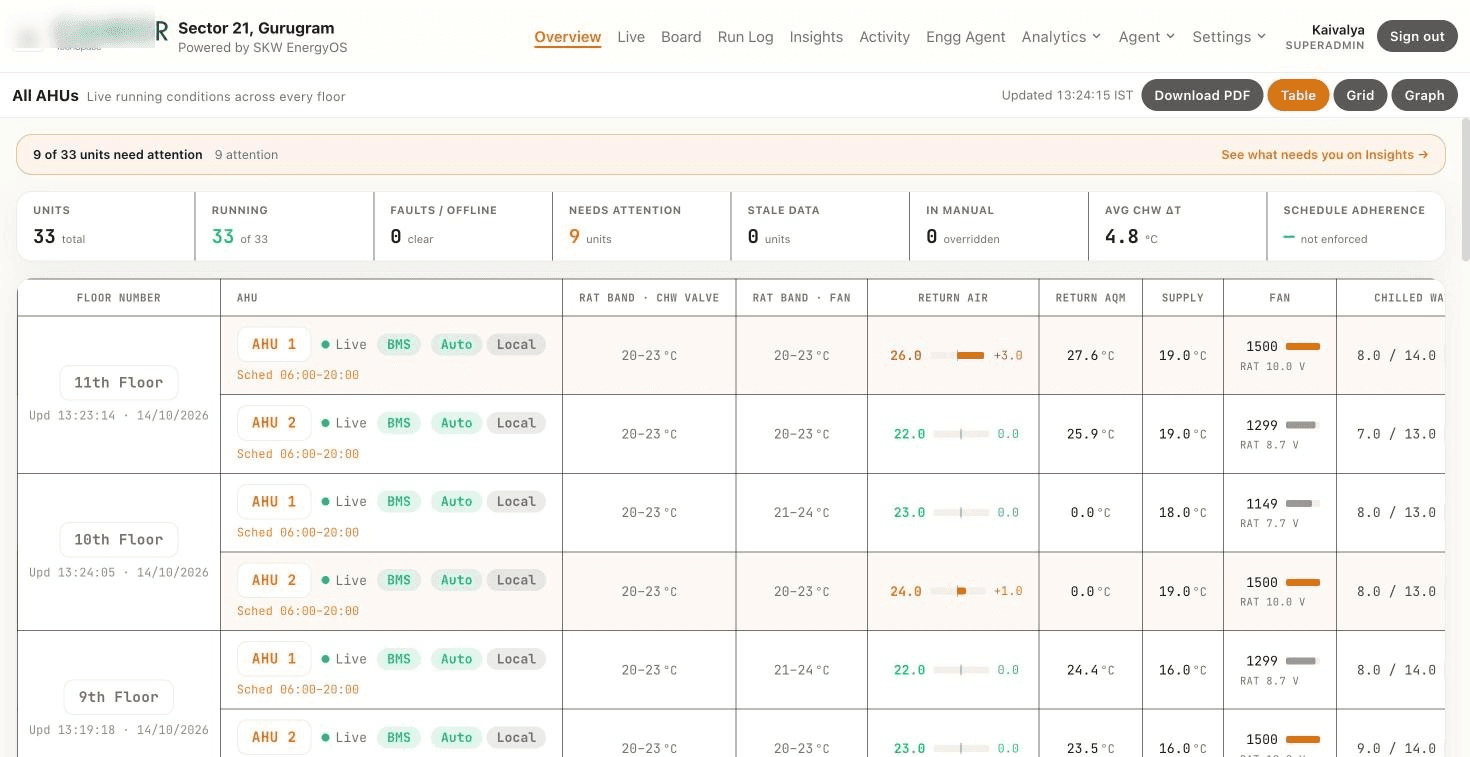
This is the deployment — AHUs under autonomous control, setpoints being written live, the safety layer green.
cycling · all 68 autonomous
uptime 12m 04d · last cmd 1s ago
Control is never handed over on day one. It is transferred gradually, only after the system has proven itself on your building.
Independent, layered safeguards — this is not marketing, it is how the system is built.
Physical limits enforced by the equipment itself — cannot be overridden by any software, including ours.
Hard limits on every controllable parameter. The system is architecturally prevented from commanding outside them.
Every command is checked against the building's live measured state before it is written.
Full suspension of all system-issued commands, available to your facility team at all times.
Revert the whole building to manual BMS control at any time, without contacting us.
Any operator instruction takes precedence over any system command. Always. No exceptions.
If the connection drops, the building keeps operating safely within its bounds.
In 12+ months across 68 AHUs, no safety bound has ever been exceeded.
Where compute is capped by power, not chips, autonomous thermal control turns freed cooling power back into usable capacity.
Roadmap — not yet in production.
Built as a fleet-learning platform, designed so every building it runs is intended to make the next one smarter.
Vision. Fleet learning is on our roadmap, not a claim about today.
Kaivalya Innovations is a physical-AI company from Gurugram, India, founded in 2024. We started with a simple observation: buildings are full of intelligence that only recommends — dashboards, alerts, reports — while the equipment still waits for a human to act. We build the layer that acts.
SKW EnergyOS is the result: an AI system that autonomously operates commercial HVAC on top of the BMS a building already owns — perceiving live state, deciding from physics, and writing setpoints in a closed loop, always inside hard safety bounds a human can override.
We earn autonomy in stages, never assume it. Our reference deployment has run itself for over a year across offices and hospitality — for operators, the proof is uptime, not slideware.
We also write — on control loops, energy, and why civilisation's story is an energy story:
Tell us about your building. We'll show you the live deployment and what autonomy would look like on your equipment.
What to expect