
The AHU is running. The floor is still warm.
Every office has one: the AHU that runs flat out while the 11th floor keeps calling the helpdesk. Here is what is usually wrong, and what it looks like when the building fixes it on its own.
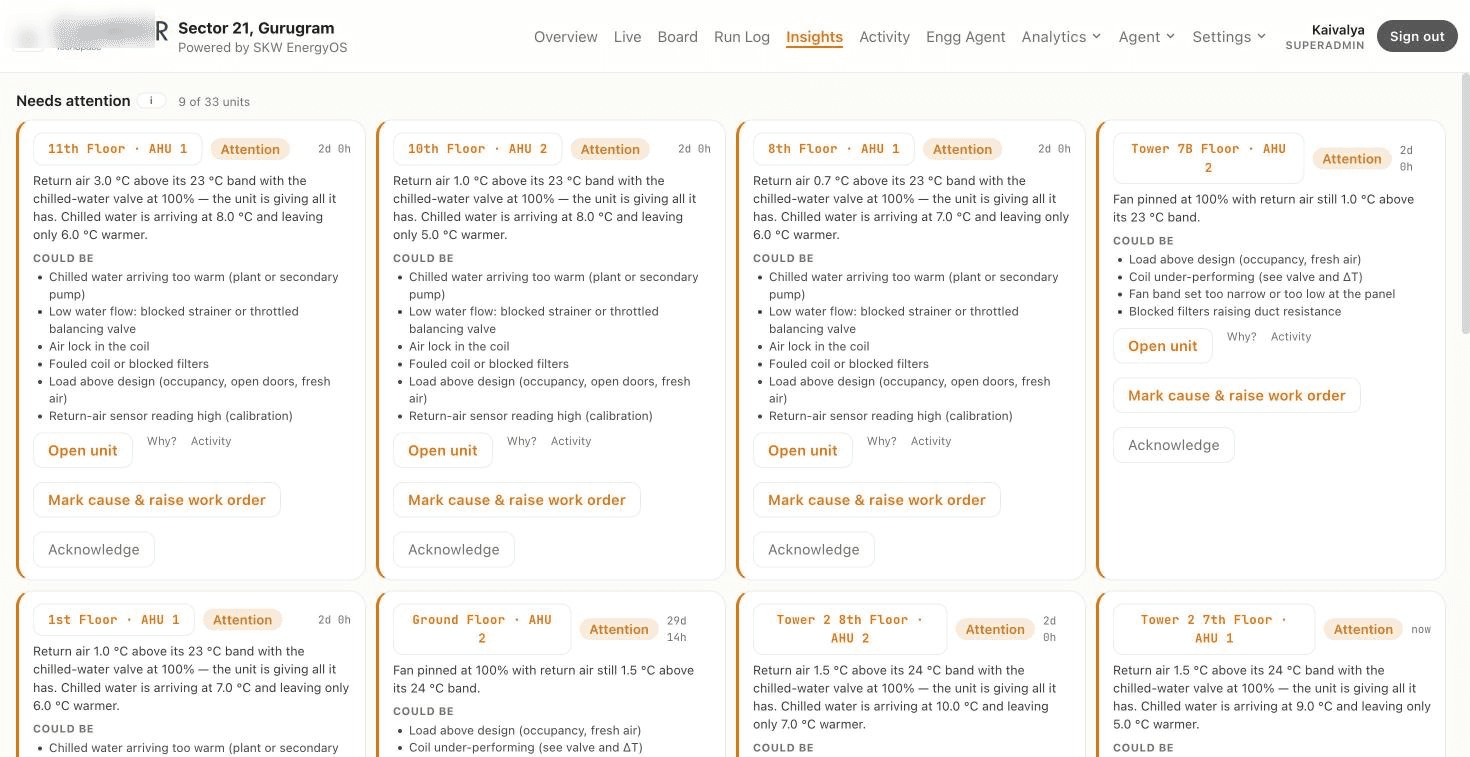
Insights at Candor TechSpace: 9 of 33 units flagged with likely causes, before anyone complained.
Why a running AHU doesn't mean a cool floor
The symptom is always the same — return air a few degrees above its band, chilled-water valve pinned at 100%, fan at full speed. The unit is giving everything it has and the floor is still warm. By the time someone walks up to the panel, the morning is gone.
The cause is rarely one thing. Chilled water arriving warmer than design from the plant. A strainer slowly blocking. An air lock in the coil. A fouled filter raising duct resistance. Load above design because a floor was re-planned for more desks. Each one looks identical from the room — and the BMS, which only executes the rules it was commissioned with, has no way to tell them apart.
Most buildings run on fixed schedules and setpoints chosen on commissioning day. Cooling starts at a fixed time whether people are there or not; the setpoint is a degree too cold because someone complained once in 2023; nobody has touched it since. The waste is invisible because nobody is measuring the gap between what the building needs and what the plant is delivering.
What changes when the building runs itself
It explains the warm floor
Instead of a red number, the system writes what is wrong — "return air 3 °C above band with the valve at 100%" — and lists the likely causes under it. One click raises the work order.
It starts cooling just in time
It learns how many minutes each floor takes to move 1 °C and reads the weather, then starts the AHU so the floor is ready when people arrive — not an hour early, not ten minutes late.
It writes the setpoints itself
Every minute, within hard bounds your team sets, on the BMS you already own. BACnet or Modbus, read-only to begin with, human override always wins.
Live across two towers at Candor TechSpace
In the comfort band, last 7 days
Flagged before anyone complained
In 12+ months of autonomous operation
Questions we get asked
Do we have to replace our BMS?
No. SKW EnergyOS sits on top of Honeywell, JCI, Siemens or Schneider BMS over BACnet or Modbus. Nothing is ripped out and your AMC contract is untouched.
Will people feel warmer to save energy?
No. The goal is the right temperature at the right time. At Candor TechSpace the floors stayed inside the comfort band 99% of the hours while the system ran itself.
How long before it is in control?
Weeks 1–6 are read-only shadow: it watches, finds problems, and shows you what it would do. Weeks 7–12 are supervised. Autonomy is handed over only after it has proven itself on your building.
What if the internet drops?
The building keeps running. Data is stored on site, a local copy of the dashboard keeps working, and the safety bounds are enforced locally.
Other buildings