
HVAC basics: the four system types, and the one question that sorts them
All-air, air-water, all-water, unitary. Every HVAC system is one of four — and you can tell which by asking what leaves the plant room. A beginner's map of the whole field.
HVAC looks like a thousand products: splits, VRF, chillers, AHUs, fan-coils, packaged rooftops. Underneath there are four systems, and the way to tell them apart is to ask one question: what medium carries the heat from the plant room to the room where people are?
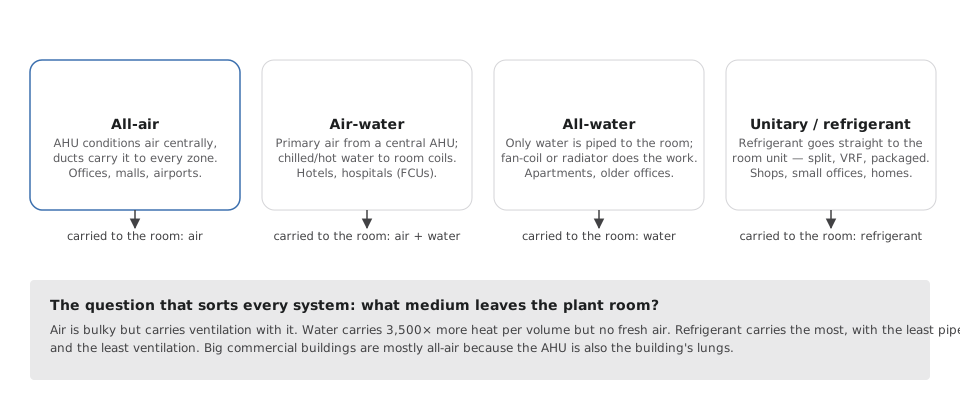
All-air
A central air-handling unit (AHU) conditions air — cools it, dehumidifies it, filters it, mixes in fresh air — and ducts carry that air to every zone. Nothing but air arrives at the room. This is most large commercial buildings: offices, IT parks, malls, airports. It is the most ductwork and the biggest fans, but it has one enormous advantage: the AHU is also the building's lungs. Ventilation and cooling arrive together.
Air-water
A smaller central AHU supplies just the fresh air the room needs (the 'primary air'), while chilled or hot water is piped to a coil in each room — a fan-coil unit or an induction unit — that does most of the heating and cooling. Hotels and hospitals are typically air-water: every room gets its own control, the ducts are small, and the heavy lifting is done by water, which carries about 3,500 times more heat per cubic metre than air.
All-water
Only water reaches the room. A fan-coil or a radiator does all the work, and ventilation is whatever comes through the windows. Cheap to install, common in apartments and older offices, and the reason so many of those buildings feel stuffy: there is no mechanical fresh air at all.
Unitary / refrigerant
The refrigerant itself is piped to the room: split units, VRF/VRV, packaged rooftop units, window ACs. The 'plant room' is an outdoor unit on the wall. This carries the most heat in the smallest pipe and needs the least central infrastructure, which is why it dominates shops, small offices and homes. The trade-off is the same as all-water: fresh air is somebody else's problem.
Why the distinction matters when you walk into a building
- All-air buildings live or die by their AHUs. Fan energy, filter condition, coil performance and the supply-air setpoint decide comfort and the bill.
- Air-water buildings have a hundred small loops. Problems are local (one room's fan-coil) and the central plant is about water temperature and pump energy.
- Unitary buildings have no central control to speak of. Energy is scattered across dozens of outdoor units, each on its own thermostat.
This blog spends most of its time on all-air systems, because that is where commercial buildings spend most of their energy — and where a controller can do the most. The next post takes the thing all four systems share apart: the refrigeration cycle.