
The refrigeration cycle, explained with one diagram
Compressor, condenser, expansion valve, evaporator. Heat is not made cold — it is moved. How the four parts move it, where the electricity goes, and what each temperature tells a technician.
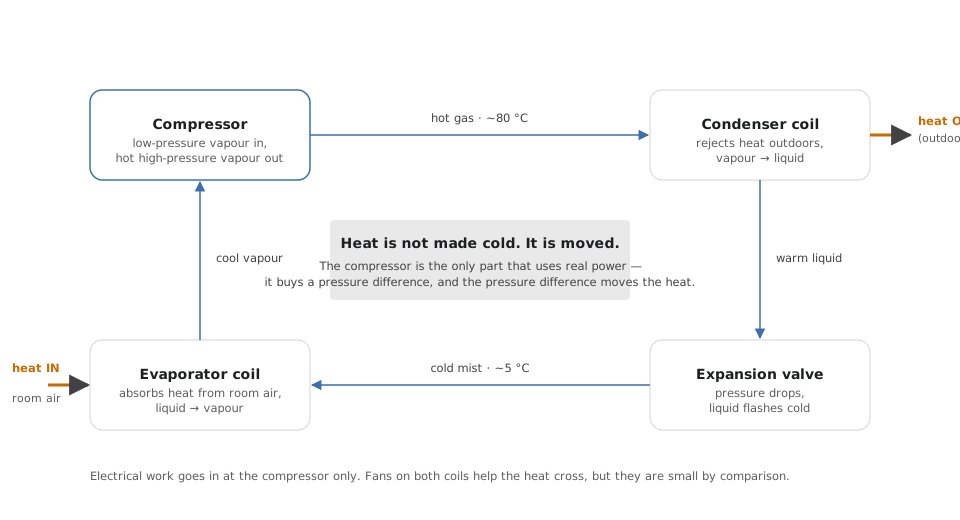
Every air-conditioner, chiller, fridge and heat pump is the same four-part loop. If you understand this one diagram you understand the heart of the whole field, and most of what a service technician measures makes sense.
The idea in one sentence
A liquid boils at a lower temperature when its pressure is low, and condenses at a higher temperature when its pressure is high. The cycle uses a pressure difference to make a refrigerant boil cold in one place (absorbing heat from the room) and condense hot in another (dumping that heat outside). The compressor is what buys the pressure difference.
The four parts
- Compressor — takes low-pressure vapour and squeezes it. Pressure and temperature both rise; the gas leaving is hot, often 70–90 °C. This is the only place real electrical power goes in.
- Condenser coil — the hot gas flows through a coil with outdoor air (or cooling-tower water) blowing across it. It gives up heat and condenses to a warm liquid at high pressure.
- Expansion valve — a deliberate restriction. The liquid drops from high to low pressure, flashes partly into vapour, and gets cold — around 5 °C in a comfort system.
- Evaporator coil — the cold mixture flows through the coil that room air passes over. It absorbs heat from the air, boils back to vapour, and returns to the compressor. The air leaving the coil is cooler and drier.
What the numbers mean on site
- Suction pressure and temperature (into the compressor) tell you how the evaporator is doing. Too low: not enough refrigerant or not enough air across the coil — dirty filter, failed fan.
- Discharge pressure (out of the compressor) tells you about the condenser. Too high: dirty condenser coil, failed condenser fan, or a hot day with nowhere to put the heat.
- Superheat (how far the suction vapour is above its boiling point) and subcooling (how far the condensed liquid is below its condensing point) are the two numbers that tell you the refrigerant charge is right. Learn to measure both.
Chillers are the same loop, with water in the middle
In a large building the evaporator cools water instead of air — that chilled water (typically 6–8 °C leaving) is pumped to the AHU coils, and the AHU coil is where the room air actually meets the cold. The condenser rejects heat to a cooling tower instead of outdoor air. The physics is identical; only the carriers change. This is why a 'chilled water arriving too warm' insight on an AHU is really a message about the chiller plant three floors down.
Where the efficiency is
The compressor's work depends on the pressure difference it must create. Anything that lets the condenser run cooler (clean coils, a cooler night, a well-run tower) or the evaporator run warmer (a higher chilled-water setpoint when the load allows) narrows that difference and cuts the electricity. Most 'AI optimisation' of a chiller plant is, at bottom, managing those two temperatures as close together as comfort allows.