
How to start an HVAC career in India: a step-by-step path from basics to building controls
Foundation, theory, hands-on, specialise. What to study, where the apprenticeships are, how residential and commercial paths diverge, and which roles are growing — a practical map for someone starting now.
HVAC is one of the few trades where demand is growing faster than the number of people who can do it, and where the ladder runs from a service van to the control room of a 500,000 sq ft campus. Here is the path, in the order it actually works.
Step 1 — Foundation
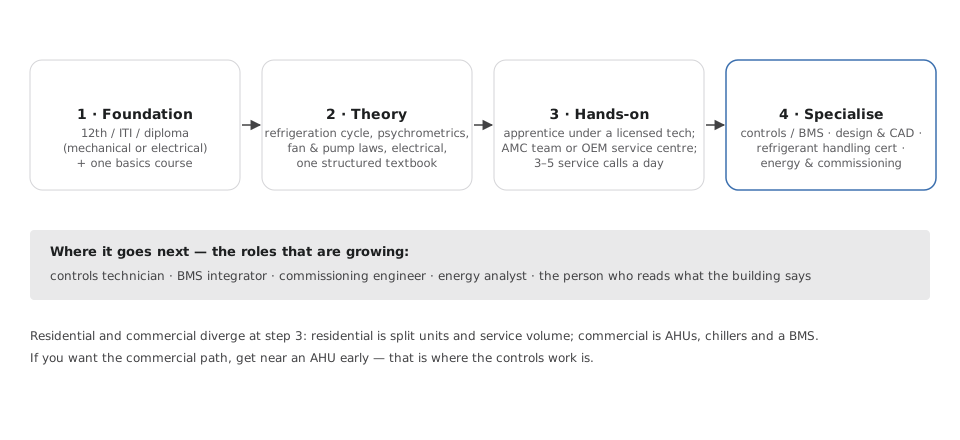
A 12th-grade science background, an ITI certificate in refrigeration and air-conditioning, or a diploma in mechanical or electrical engineering. Any of these is enough to start. Add one structured basics course — there are good free and low-cost online ones — so the vocabulary is in place before you touch equipment: the four system types, the refrigeration cycle, psychrometrics, the fan laws.
Step 2 — Theory, from one book
Pick one well-structured textbook or trainee guide and finish it. The topics that matter most, in rough order: the refrigeration cycle and how to read its pressures and temperatures; psychrometrics (what humidity does to comfort and coil load); electrical basics (contactors, capacitors, relays, reading a wiring diagram, using a multimeter); fan and pump laws; ventilation and filtration standards. The ISHRAE and ASHRAE handbooks are the references the industry actually uses — you don't read them cover to cover, you learn where things are.
Step 3 — Hands-on
Nothing replaces working under a licensed technician. The two main routes in India are an OEM service centre (split and VRF manufacturers run large field teams) or an AMC contractor that maintains commercial plant. Residential service is 3–5 calls a day on split units — fast, high-volume, mostly electrical and refrigerant work. Commercial is AHUs, chillers, cooling towers, pumps and a BMS — slower, bigger, and the path toward controls.
- First year: learn to diagnose by measurement, not by replacing parts. Superheat, subcooling, amps against FLA, filter ΔP.
- Second year: get near an AHU. Learn what each section does and what the BMS reads from it.
- Then: ask to sit with the BMS operator. The person who can read what the building is saying is the one who gets promoted.
Step 4 — Specialise
- Controls and BMS integration — BACnet, Modbus, the sequence of operations. The most under-supplied skill in the market.
- Design and CAD — duct and pipe sizing, load calculations, drafting. The consultant route.
- Refrigerant handling and safety certification — required for anyone working on the circuit, and increasingly audited.
- Commissioning and energy — testing, balancing, measurement and verification. Where the money is in retrofits.
The roles that are growing
Installer and maintenance technician will always be the volume roles. The ones growing fastest are controls technician, BMS integrator, commissioning engineer and energy analyst — because buildings are being asked to run on data, and someone has to connect the equipment, read the numbers and act on them. An AHU that explains its own problems in plain English still needs a person who can open the unit and fix the strainer. That person is more valuable, not less.
A note on where this blog fits
We build software that operates HVAC autonomously. We write these fundamentals because the people who understand the equipment are the ones who get the most out of the software — and because the industry needs more of them. If you are starting out and want to see what a building looks like from the control room, the product tour on the homepage is the real thing, running.