
Thermal comfort is four variables, not one thermostat
Air temperature, radiant temperature, humidity and air speed — plus clothing and activity. Why a room at the right temperature still gets complaints, and what a controller should actually target.
The thermostat reads one number. People feel four. Most comfort complaints in a building that is 'at setpoint' come from the three the thermostat doesn't see.
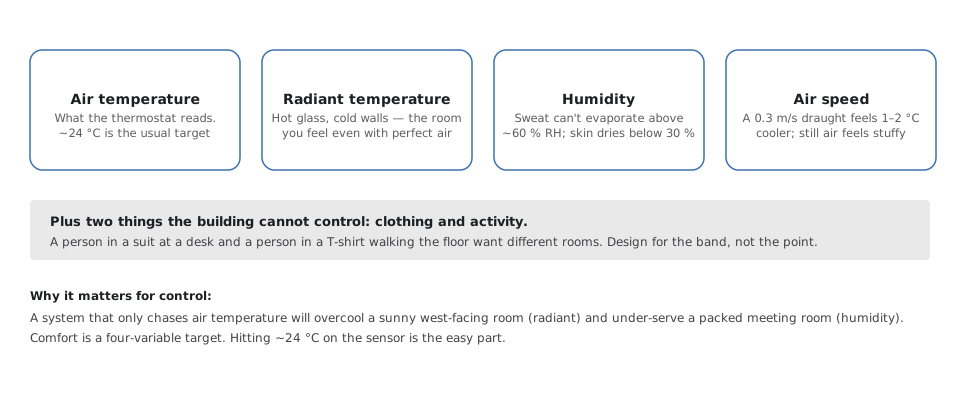
Air temperature
The easy one. Around 24 °C is the usual target in Indian commercial buildings; the comfort band is typically a degree or two either side. A room that sits inside its band 99% of occupied hours is doing well — that is the figure we report per AHU in the monthly performance report.
Radiant temperature
Your body exchanges heat by radiation with the surfaces around you. A west-facing glass wall at 4 p.m. can be 35 °C while the air is 24 °C, and the person next to it is hot. A cold concrete wall in January does the opposite. Air temperature alone cannot fix a radiant problem — you overcool the whole floor trying, and the people away from the window freeze. Shading and surface treatment are the real fix; the controller's job is not to chase it with the AHU.
Humidity
Sweat cools you only if it can evaporate. Above roughly 60% relative humidity, it can't, and 24 °C feels like 27. Below 30% RH, skin and eyes dry out. In a monsoon climate the cooling coil does more dehumidification than cooling — which is why a coil that is too warm (chilled water arriving above design) produces a floor that is 'at temperature' and still sticky.
Air speed
Moving air feels cooler: 0.3 m/s across the skin is worth about 1–2 °C. A ceiling fan is the cheapest comfort device there is. The flip side is draught — the same air speed from a diffuser aimed at the back of someone's neck is a complaint, not a comfort.
The two the building cannot control
Clothing and activity. A person in a suit at a desk and a person in a T-shirt walking the floor want different rooms. The honest answer is a band, not a point: hold the floor inside a range, keep humidity under control, and let the people inside adjust the last degree themselves.
What this means for control
- Target the return-air band, not a single setpoint. A band gives the controller room to save energy without anyone noticing.
- Watch humidity as a first-class variable. A coil valve at 100% with return air still above band is often a latent (humidity) load, not a sensible one.
- Treat radiant complaints as a building problem. If one zone always complains at 4 p.m., the fix is shading, not a colder AHU.