
Indoor air quality: source control, filtration, dilution — and why CO₂ is the number to watch
The three-step IAQ hierarchy, what MERV ratings actually mean, and how a CO₂ reading tells you the ventilation rate without measuring airflow.
Indoor air quality has three levers, and they should be pulled in order, because each one costs more energy than the one before it.
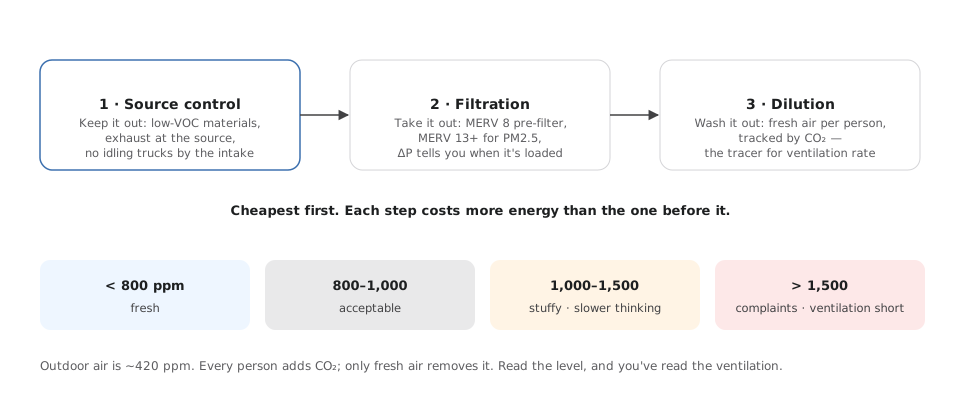
1. Source control — keep it out
Low-VOC paints and furniture, exhaust hoods at the source (pantries, print rooms, labs), and an outdoor-air intake that isn't next to the loading dock or the DG exhaust. Nearly free, and the step most often skipped at fit-out.
2. Filtration — take it out
Filters are rated by MERV (Minimum Efficiency Reporting Value) from 1 to 16. A MERV 8 pre-filter catches dust and pollen; MERV 13 and above catch a meaningful fraction of PM2.5, which is what matters in a North Indian winter. Finer filters cost fan energy: the pressure drop across a clean MERV 13 is higher than a MERV 8, and it rises as the filter loads. That is why the AHU has a ΔP sensor across the filter bank — when the drop crosses the threshold, the fan is working harder to push the same air and it is time to change the filter.
3. Dilution — wash it out
Fresh air from outside, in proportion to the number of people. Standards express this as litres per second per person plus an allowance per square metre. The energy cost is real: every cubic metre of outdoor air at 40 °C must be cooled and dehumidified before it reaches the room. Over-ventilating an empty floor is one of the quietest ways a building wastes money; under-ventilating a full one is how it gets stuffy.
Why CO₂ is the number
You can't easily measure ventilation rate in a working building. But you can measure CO₂. Outdoor air is around 420 ppm. Every person exhales CO₂ at a known rate; only fresh air removes it. So the steady-state level in an occupied room is a direct function of how much outdoor air each person is getting — read the ppm and you have read the ventilation.
- Below ~800 ppm: well ventilated.
- 800–1,000 ppm: acceptable for offices.
- 1,000–1,500 ppm: stuffy. Published studies measure slower decision-making from around 1,000 ppm — before anyone feels uncomfortable.
- Above 1,500 ppm: complaints, headaches, the 3 p.m. slump. The fresh-air damper is closed or the room is over-occupied.
The decay matters too: when a room empties, how fast CO₂ falls back toward outdoor levels tells you the air-change rate. That is how a clean room can verify its ventilation continuously rather than once a year with a grille test — a CO₂ logger and a chart.
What a smart building does with it
Demand-controlled ventilation: open the fresh-air damper when CO₂ rises, close it when the floor empties. More fresh air only when rooms get stuffy, not the same fresh air all day. On an AHU this is one of the largest single savings available, and it makes the air better at the same time.