
Why an EC fan's DC bus reads ~540 V, and what it means when it doesn't
A 415 V three-phase supply rectifies to about 560 V DC and sags under load. How to confirm the register scale from physics alone, and why the drive's three fault flags in 24 hours all line up with bus dips.
The first thing a logged register makes you do is doubt it. bus_v_raw hovers between 520 and 560. Is that 540 volts, 54 volts, or something else? You can settle it without the manual.
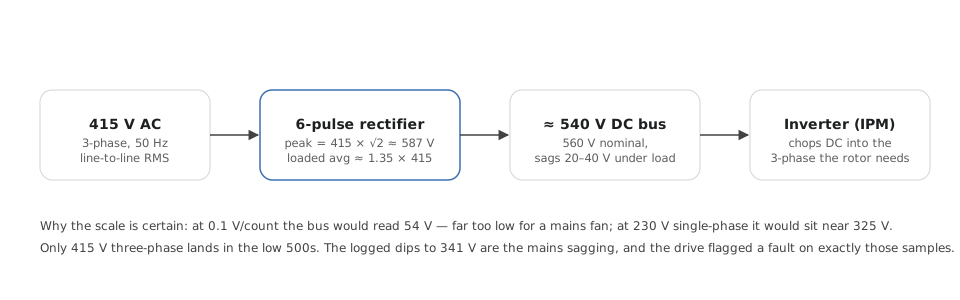
The arithmetic
A three-phase rectifier charges its DC-bus capacitors toward the peak of the line-to-line voltage: 415 V RMS × √2 ≈ 587 V. Under load the bus settles lower, and the standard rule of thumb for a six-pulse rectifier is about 1.35 × line voltage, so 415 × 1.35 ≈ 560 V. Loaded, with a little cable drop, the low 500s to 550s are exactly what you expect.
Now try the alternatives. At 0.1 V per count the bus would be 54 V — impossible for a mains-fed fan. If the fan were single-phase 230 V, the bus would sit near 325 V, or 380–400 V with a power-factor-correction stage. Neither matches. The scale is 1 V per count, the supply is 415 V three-phase, and the jitter of ±15 V from sample to sample is what a loaded rectifier does.
Three faults, three sags
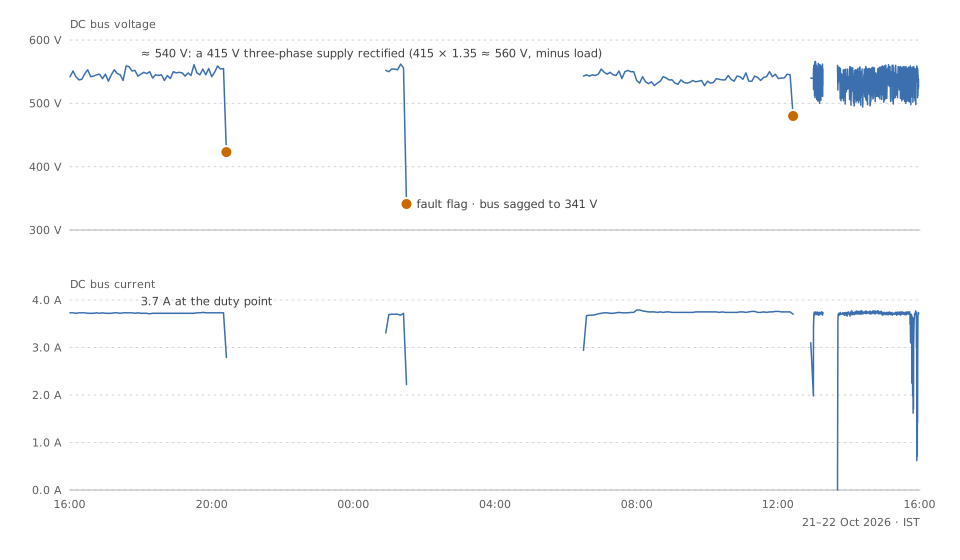
In 24 hours the drive raised its fault flag on exactly three samples. On every one of them the bus voltage had collapsed: 423 V, 341 V and 480 V against a normal 540. The current fell with it and the fan slowed — to 986 rpm, 792 rpm and (on the third) held at 1,313 rpm with a reduced setpoint. The drive wasn't failing. The mains dipped, the bus dropped below the inverter's under-voltage threshold, and the fan protected itself. A sag to 341 V on a 560 V bus is a mains dip of roughly 40% — the kind a DG changeover or a large motor starting elsewhere on the feeder produces.
What to do with that
- Log bus voltage alongside the fault flag. A fault with a sag is a power-quality problem, not a fan problem — don't replace the fan.
- Correlate across fans. If every EC fan on the floor flags at the same second, look at the incoming supply or the changeover panel.
- Watch the recovery. A healthy drive clears the fault and ramps back on its own; in our data, the fan was back at 1,309 rpm within the next sample.
Current, and the number that falls out
current_raw sits at 370–375 at the duty point, 0.01 A per count: about 3.7 A on the DC bus. Volts times amps is power — around 2.0 kW — which the next post uses to test the fan laws against a real machine.