
Measuring fan power from the DC bus — and testing the cube law on a real EC fan
Bus volts × bus amps gives fan power with no meter. Plotted against speed, a real EC fan lands between the square law and the cube law — here is why, and what it means for savings estimates.
The fan laws say power scales with the cube of speed: run a fan at 80% speed and you use 51% of the power. It is the single most-quoted fact in HVAC energy work, and it is a little too good to be true. Here is what one real fan does.
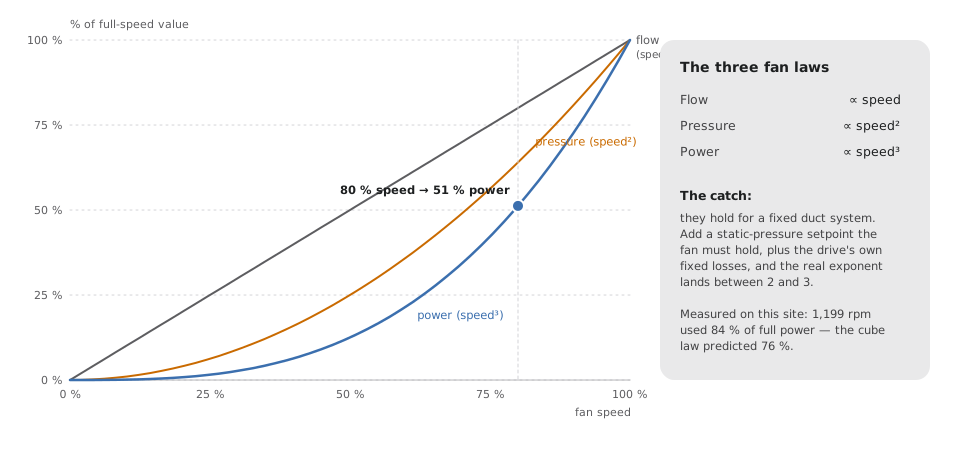
Power from the drive, no meter
An EC fan reports its DC-bus voltage and DC-bus current. Multiply them and you have the electrical power entering the inverter. On this fan at its 1,315 rpm duty point: ≈ 537 V × 3.72 A ≈ 2.0 kW. That is the input to the inverter, so it includes the inverter's own losses and the motor's — which is exactly what you pay for at the meter.
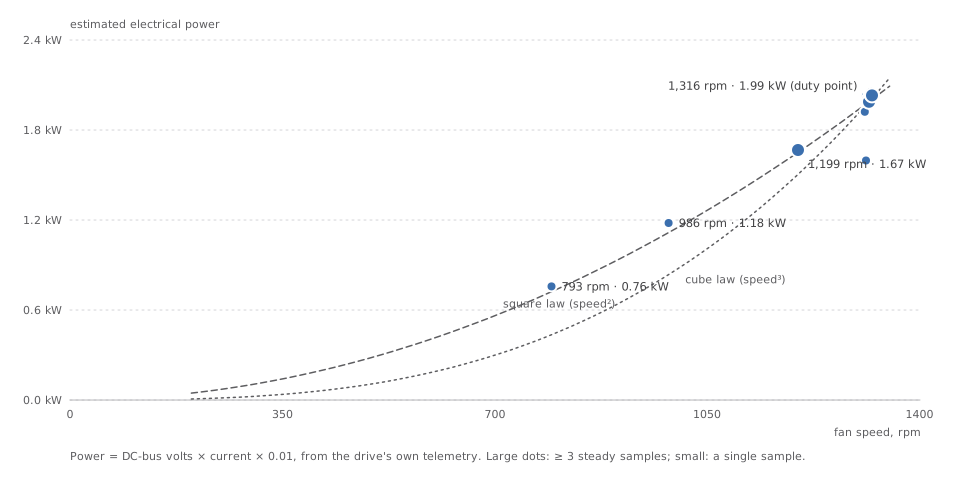
What the data says
Anchor the cube law at the duty point (1,316 rpm, 1.99 kW) and it predicts 1.51 kW at 1,199 rpm — 76% of full power. The fan actually drew 1.67 kW, 84%. The square law predicts 1.65 kW, which is closer. Two lower points (986 rpm at 1.18 kW, 793 rpm at 0.76 kW) sit above the cube curve too — though honesty requires a caveat: both are single samples captured during the mains sags described in the previous post, so their absolute values are less certain.
Why real fans don't follow the cube
- The cube law assumes the system resistance is fixed and purely frictional — pressure rises with the square of flow, so power rises with the cube. A real AHU holds a duct static-pressure setpoint: part of the pressure is constant regardless of flow, and that part pulls the exponent toward 2.
- Drives and motors have fixed losses — the inverter's switching, the control electronics, bearing friction — that don't fall with speed. At low speed they are a bigger fraction of the total.
- Motor efficiency is not constant. EC motors hold it better than induction motors, but it still falls off at very low load.
The practical result: a real exponent between 2 and 3 — typically 2.2 to 2.7 on a well-controlled AHU. Reduce speed by 20% and expect to save 35–45%, not 49%. Still a large number. Just not the one on the slide.
Why this matters for savings claims
A proposal that assumes the cube law over-promises by a third at part load. Measure instead: an EC fan gives you power for free, and a week of rpm and kW at a few setpoints gives you the exponent for that fan in that duct. Our own savings figures are reported per site after a billing cycle for exactly this reason — the physics tells you the shape, the building tells you the number.