
What the inverter temperature on an EC fan is really telling you
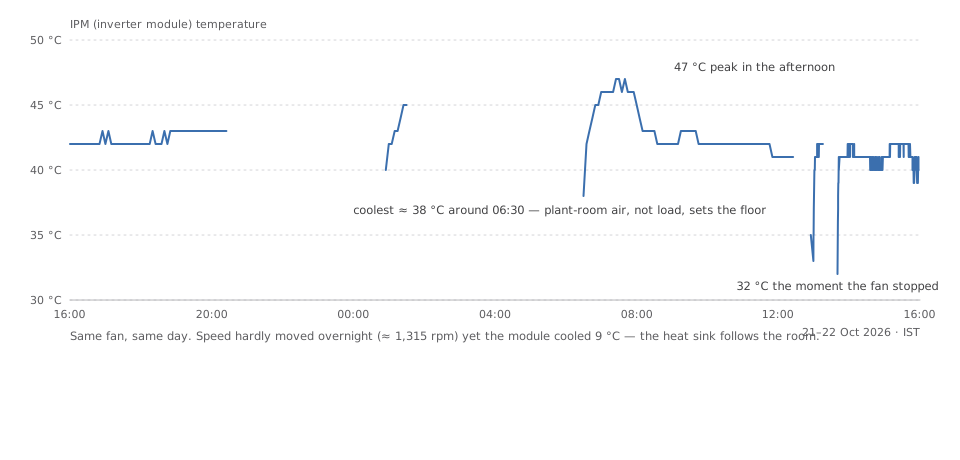
The IPM heat sink on this fan swung from 32 to 47 °C in a day while the speed barely moved. It tracks the plant room, not the load — and that is exactly why it is a useful alarm.
Every EC fan reports an inverter module temperature — ipm_temp_c in our registers. It is tempting to read it as a load signal. On this fan, it isn't.
What the day looked like
The fan ran at about 1,315 rpm and 2 kW the whole night. Its IPM read 42–43 °C in the evening, drifted down to 38 °C around 06:30, climbed to 47 °C by mid-afternoon, and sat at 41–42 °C during the test. The one time it moved sharply was when the fan stopped for a moment at 13:40 — it dropped to 32 °C within the sample, because the heat sink was suddenly being cooled by a stationary fan's residual airflow and the ambient, with no switching losses.
Correlation with speed over the day: 0.32. Correlation with estimated power: 0.30. Weak. The inverter's losses at constant load are constant; what changed was the temperature of the air cooling the heat sink — the plant room, which warms through the afternoon and cools overnight.
So what is it for?
- A rising IPM temperature at constant speed means the cooling of the heat sink has degraded: dust on the fins, a blocked housing vent, or the plant room running hot because an exhaust fan failed. That is a maintenance alarm before it is a drive failure.
- The spread between fans matters more than the absolute value. Six identical fans in a wall should run within a few degrees of each other. One running 10 °C hotter has a problem the others don't.
- The ceiling is what the drive derates at — typically in the 70–85 °C range depending on the model. At 47 °C there is plenty of margin; a plant room at 50 °C ambient would eat most of it.
Trend it against the room, not the load
The useful chart is IPM temperature minus plant-room air temperature. That difference is the inverter's own thermal signature, and it should be nearly flat at constant speed. When it starts rising, the heat is not getting out. Log the room, subtract, and alarm on the difference.